THE SECOND LIFE
The upload is only the beginning.
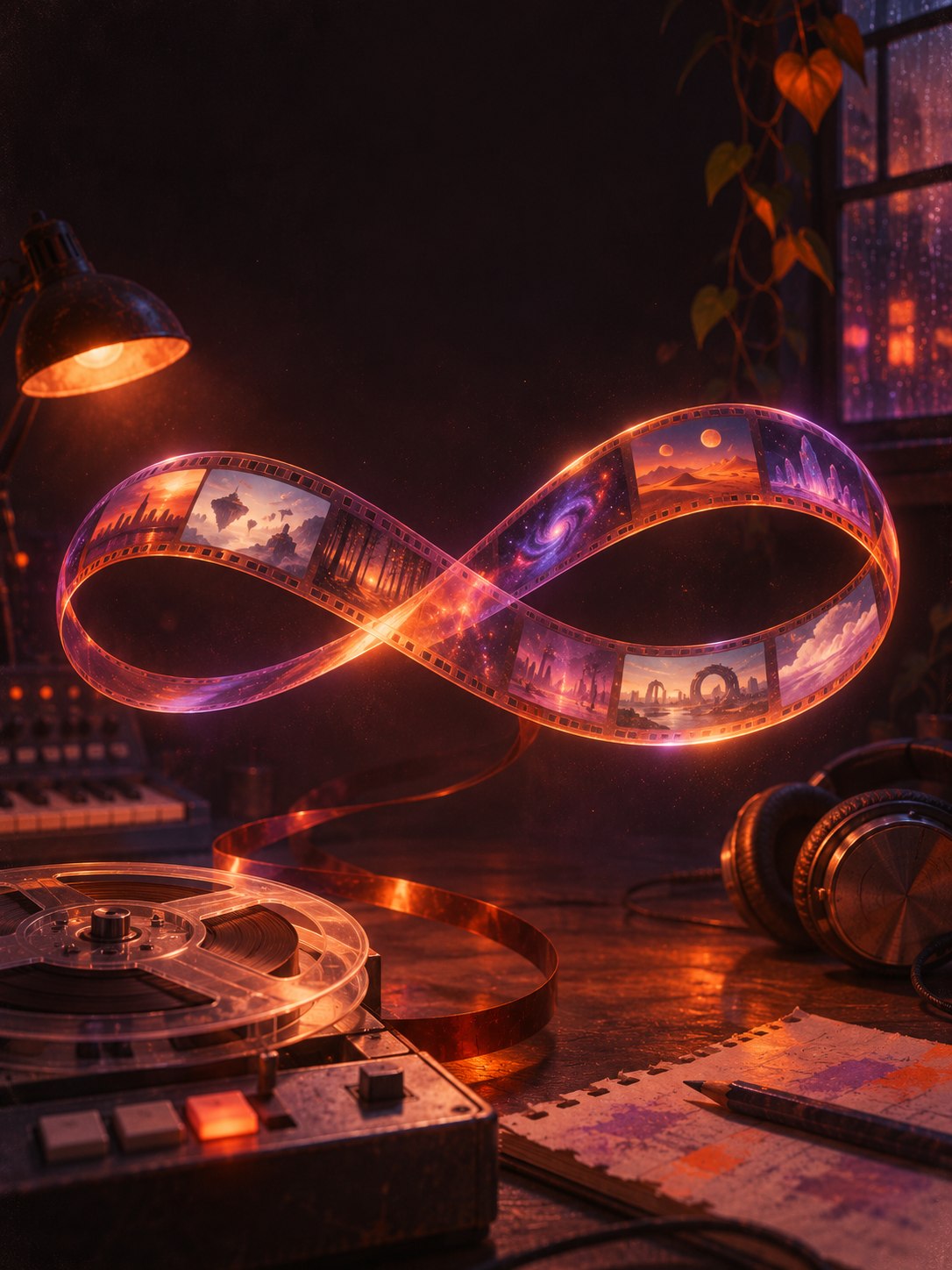
SONGS WORTH REPLAYING.
VIDEOS WORTH REMAKING.
WORK WORTH REMEMBERING.
The upload is only the beginning.
SONGS WORTH REPLAYING.
VIDEOS WORTH REMAKING.
WORK WORTH REMEMBERING.
The first watch can be a rush. The second is where a scene starts to take shape.
This issue asks what remains after the clip has stopped moving through a feed. Does the song call you back? Can another maker build a new world around it? Can someone tell who made what? Will the link still mean anything a year from now?
We found promising examples in a song that gained another video, an elevator imagined as a time machine, a country that charges visitors their sleep, and a creator looking back at an early work. None of these is a rule for Slopcore. They are doors into the culture it could become.
In this issue: The replay test · One song, two worlds · Smaller stories · Series and rituals · Credits · Memory · An invitation · Around the scene.
The feed rewards arrival. Here is a new song. Here is an impossible face. Here is a shot that would have cost a fortune a few years ago. You stop scrolling for a moment, and then the next clip begins.
That moment matters. It is how strangers discover each other. But it cannot be the whole ambition.
Calling it slop suggests it will be disposable. The second life is where that assumption gets tested.
A culture grows when a piece of work keeps doing things after its premiere. A listener returns for a line. Another creator answers with a different video. Someone asks who made the voice or designed the character. A curator keeps the original link beside the new interpretation. A conversation becomes part of the record.
This is the second life of a Slopcore work. It is quieter than launch day and potentially more important.
Slopcore is unusually good at making people look up. Its videos can put an entire artificial world on the screen before the first chorus. A perfect face, a scanner overlay, a sudden transformation, a joke that lands in one frame.
Now close the tab. What do you remember of the song?
That question is not a demand for every track to stand apart from its film. Some works are built as inseparable audio and image. But it is a useful challenge for makers: a hook, a rhythm, a strange lyric, or a voice with a point of view can outlive the visual surprise.
The scene will not run out of new models. Its harder task is making something a listener chooses to hear again.
Luna MAX's post for Hate Me, Replay Me describes neon cities, a stadium finale, and lyrics that react to the beat. Then it turns the listener's attention back to the words. The creator asks whether the audience heard them on replay.
That is an interesting invitation. A video can dazzle on the first pass and reveal its warning on the second. The image draws you in; the song asks whether you were paying attention.
We should make room for that kind of delayed effect. A chorus can mean one thing with the screen on and another after the viewer knows the ending. The best reason to press replay may be curiosity rather than spectacle.
Listening prompt: Notice what you remember before returning. Then listen once without watching.
What happens when somebody keeps the song and changes the film?
SlopHits separates original works, covers, and new videos for existing songs. That small distinction creates room for a bigger conversation. A new video need not erase the first one. It can answer it, challenge its mood, or reveal a detail the original left in the background.
This is familiar territory for music. Songs have long survived new singers, arrangements, live performances, and unofficial memories. AI video gives the visual side of that tradition a faster route. The same track can become a comedy, a dream, a protest, or a private diary.
The exciting question is not which version wins. It is what each maker heard in the song.
Pavel Kasík's original post introduced We Found Other Agents as a music video about a swarm of AI agents. Four days later, Nathan Calvin posted another video using the song. SlopHits catalogs the two as an original and a new video.
Nathan's post describes being unable to get the song out of his head, trying a prompt from another maker, and iterating on the result. That is more than a second upload. It shows a chain of influence: one song inspires another visual attempt, while a process idea travels between creators.
We cannot infer license or permission from those posts. A healthy version culture should make those relationships easy to see: name the song's originator, credit the new visual maker, and link both works. If reuse needs consent, ask for it.
The setting of an AI music video does not have to be a neon city or the end of civilization.
For Hold the Lift, Jamian Gerard describes a UK garage track and a video shaped by the playful music-video language of the late 1990s and early 2000s. The premise starts with a simple idea: if you cannot afford a time machine, take the lift.
That is a useful lesson in scale. A doorway can be more memorable than an entire generated metropolis when it gives the audience a question to follow. Where does the lift go? Who steps out? What changes when the doors open?
The production tools matter, and the creator names them in the original post. The reason to start watching is the idea.
keiru AI Lab presents Insomnialand as a country for people who cannot sleep, with sleep itself as the admission price. The creator says the piece mixes live action with a Blender 3D world, and names Remotion and Seedance among the video tools.
The production note is useful, but the premise does the heavier work. It turns an ordinary human condition into a place. The viewer does not need a rulebook to understand the invitation.
Slopcore can have room for these smaller, stranger entrances: a lift, a sleepless country, a room that changes with the chorus. An impossible world becomes easier to care about when it begins with a feeling someone recognizes.
Source note: Production details here come from the creator's own announcement.
A song can get a second life through a new interpretation. A creator can also give the audience a recurring appointment.
In a November 10 post, Coffee and Grit calls Real Men Manage Their Own Memory the thirteenth night of a series turning public posts into music videos. The subject is technology news, but the format is the point here: a repeatable idea invites the audience to come back for the next installment.
Serial work can become a small ritual. A title card, a familiar voice, a new angle on the day's material, and an archive that lets newcomers start at the beginning. It also gives a creator a way to improve in public. The audience can see the craft changing from episode to episode.
The scene needs room for albums, one-offs, and experiments. It may also need shows.
AI music videos are often described as if a single model made them. The actual work may include a song, a voice, a character design, source footage, generated shots, compositing, editing, and a last-minute decision to throw away the shot that cost the most.
Creator notes make this chain visible. Jamian Gerard names the video service behind Hold the Lift. keiru lists live action alongside 3D and generation tools for Insomnialand. Nathan Calvin points to another maker's prompt while describing his new video for We Found Other Agents.
Credits do not reduce the magic. They tell us where to look for the human choices and the borrowed ideas. They also let someone give useful praise: the edit worked, the song held together, the strange premise made the world legible.
If Slopcore wants a history, it needs names attached to decisions.
A creator does not need a production diary for every upload. A short note can do real work:
Song: title, writer or composers, vocalist or voice source.
Video: director, editor, performers or character creators.
Tools: models and services that materially shaped the result.
Sources: samples, licensed material, references, and permissions.
Versions: original release and any later edits or authorized remakes.
Home: a stable link where the work and its credits live.
The point is not to turn a song into a receipt. It is to make the path through the work visible. Credits help listeners find the people behind a favorite moment and help makers find each other.
If a credit is uncertain, say so. If the work changes, update the note. A culture can learn to be precise without becoming stiff.
Feeds are excellent at showing what is new. They are less reliable as a history. A title can change. A post can be removed. A video can be reposted without its maker's name. A number that mattered on launch day can become meaningless by the next week.
The answer is not to freeze the scene. It is to leave a trail: original links, creator names, dates, version notes, captions, and corrections. A magazine can do some of that work. So can a creator's own page or a well-kept community index.
When RedSpice𝕏 looked back at Clichés, the post framed the video as an early work and invited comparison with what came later. That kind of retrospective needs an earlier work people can still find.
The archive is not an attic. It is how a new maker discovers a lineage.
SlopHits gathers creator posts and marks covers and new videos. SlopcoreVibe catalogs public posts with creator, tool, and method views. These projects make a fast-moving scene easier to explore. Their lists are especially useful when you want to follow a maker or find the original post behind a clip.
No index can decide what the culture should value. Rankings move. Search terms favor familiar words. A funny one-minute piece and a slow, uncomfortable six-minute work ask for different kinds of attention.
That leaves room for editors, fans, and creators to make their own paths through the material. Build a playlist around a mood. Keep a list of daring first attempts. Point to a second video for an old song. Write down why you returned.
The archive finds the door. A listener still has to walk through it.
The second-listen club. Share a song once with its video and once without it. Ask what changed. The answers might be more useful than a score.
One song, two worlds. With the original maker's permission where needed, invite a second filmmaker to give a track a different setting or mood. Put both versions and both sets of credits in one place.
The one-year note. Revisit an early video. Name one thing you would change, one thing you would keep, and one accident you still love. The scene can learn from its drafts as well as its polished releases.
These are invitations, not contests. No prize money is required. The value is in the exchange: someone listens closely, someone makes a new choice, someone leaves a better record for the next person.
Maybe a replay. Maybe a new video. Maybe a credit that sends you to a creator you had never heard of. Maybe an old link that still works when the feed has forgotten the song.
The Slopocalypse is interested in all of it: the strange work, the small experiments, the unfinished ideas, and the people making a scene out of repeated choices.
Have a work we missed, a version of someone else's song, or an idea that deserves a closer look? Send it through SlopRevolt's contact page. Include the original source link, creator credits, and what you want readers to notice.
SLOP REVOLT / KEEP THE SIGNAL.
Event listings checked 11 November 2026. These dates can change. Follow each organizer's link for current entry rules, tickets, and times before making plans.
Online · Claudia music-video contest, Round 2 · Closes Friday, 13 November 2026. Anabology's announcement says a second round is open for videos featuring Claudia, with judged and community-voted prizes. This is a Slopcore creator event. The short deadline makes it especially important to recheck before this issue goes live.
Bangkok, Thailand · AI Song Contest award show · 29 November 2026. The organizer's site lists an award show in Bangkok and says public voting is open as of this issue's research date. This is a broader AI music event, not a Slopcore-specific gathering.
Toronto, Canada · AI Slop Film Festival, Season 2 · 23 January 2027. The festival organizer lists an in-person screening at Rumiversal Studio and a final film-submission deadline of 16 December 2026. It welcomes AI films and experimental work. This is adjacent to Slopcore's video culture; the organizer does not describe it as a Slopcore event.
Know of a Slopcore show, screening, listening party, or creator meetup elsewhere? Send the organizer's public announcement, date, city or online link, and contact details through SlopRevolt's contact page. We will verify it before listing it.
ISSUE 003 / 11 NOV 2026
The upload is only the beginning.
02 / 17 · Inside the issue
The first watch can be a rush. The second is where a scene starts to take shape.
This issue asks what remains after the clip has stopped moving through a feed. Does the song call you back? Can another maker build a new world around it? Can someone tell who made what? Will the link still mean anything a year from now?
We found promising examples in a song that gained another video, an elevator imagined as a time machine, a country that charges visitors their sleep, and a creator looking back at an early work. None of these is a rule for Slopcore. They are doors into the culture it could become.
In this issue: The replay test · One song, two worlds · Smaller stories · Series and rituals · Credits · Memory · An invitation · Around the scene.
03 / 17 · The first upload is a beginning
The feed rewards arrival. Here is a new song. Here is an impossible face. Here is a shot that would have cost a fortune a few years ago. You stop scrolling for a moment, and then the next clip begins.
That moment matters. It is how strangers discover each other. But it cannot be the whole ambition.
Calling it slop suggests it will be disposable. The second life is where that assumption gets tested.
A culture grows when a piece of work keeps doing things after its premiere. A listener returns for a line. Another creator answers with a different video. Someone asks who made the voice or designed the character. A curator keeps the original link beside the new interpretation. A conversation becomes part of the record.
This is the second life of a Slopcore work. It is quieter than launch day and potentially more important.
04 / 17 · The replay test, part one
Slopcore is unusually good at making people look up. Its videos can put an entire artificial world on the screen before the first chorus. A perfect face, a scanner overlay, a sudden transformation, a joke that lands in one frame.
Now close the tab. What do you remember of the song?
That question is not a demand for every track to stand apart from its film. Some works are built as inseparable audio and image. But it is a useful challenge for makers: a hook, a rhythm, a strange lyric, or a voice with a point of view can outlive the visual surprise.
The scene will not run out of new models. Its harder task is making something a listener chooses to hear again.
05 / 17 · The replay test, part two
Luna MAX's post for Hate Me, Replay Me describes neon cities, a stadium finale, and lyrics that react to the beat. Then it turns the listener's attention back to the words. The creator asks whether the audience heard them on replay.
That is an interesting invitation. A video can dazzle on the first pass and reveal its warning on the second. The image draws you in; the song asks whether you were paying attention.
We should make room for that kind of delayed effect. A chorus can mean one thing with the screen on and another after the viewer knows the ending. The best reason to press replay may be curiosity rather than spectacle.
Listening prompt: Notice what you remember before returning. Then listen once without watching.
06 / 17 · One song, two worlds
What happens when somebody keeps the song and changes the film?
SlopHits separates original works, covers, and new videos for existing songs. That small distinction creates room for a bigger conversation. A new video need not erase the first one. It can answer it, challenge its mood, or reveal a detail the original left in the background.
This is familiar territory for music. Songs have long survived new singers, arrangements, live performances, and unofficial memories. AI video gives the visual side of that tradition a faster route. The same track can become a comedy, a dream, a protest, or a private diary.
The exciting question is not which version wins. It is what each maker heard in the song.
07 / 17 · A case in two links
Pavel Kasík's original post introduced We Found Other Agents as a music video about a swarm of AI agents. Four days later, Nathan Calvin posted another video using the song. SlopHits catalogs the two as an original and a new video.
Nathan's post describes being unable to get the song out of his head, trying a prompt from another maker, and iterating on the result. That is more than a second upload. It shows a chain of influence: one song inspires another visual attempt, while a process idea travels between creators.
We cannot infer license or permission from those posts. A healthy version culture should make those relationships easy to see: name the song's originator, credit the new visual maker, and link both works. If reuse needs consent, ask for it.
08 / 17 · Smaller stories, bigger doors
The setting of an AI music video does not have to be a neon city or the end of civilization.
For Hold the Lift, Jamian Gerard describes a UK garage track and a video shaped by the playful music-video language of the late 1990s and early 2000s. The premise starts with a simple idea: if you cannot afford a time machine, take the lift.
That is a useful lesson in scale. A doorway can be more memorable than an entire generated metropolis when it gives the audience a question to follow. Where does the lift go? Who steps out? What changes when the doors open?
The production tools matter, and the creator names them in the original post. The reason to start watching is the idea.
09 / 17 · A place made from a feeling
keiru AI Lab presents Insomnialand as a country for people who cannot sleep, with sleep itself as the admission price. The creator says the piece mixes live action with a Blender 3D world, and names Remotion and Seedance among the video tools.
The production note is useful, but the premise does the heavier work. It turns an ordinary human condition into a place. The viewer does not need a rulebook to understand the invitation.
Slopcore can have room for these smaller, stranger entrances: a lift, a sleepless country, a room that changes with the chorus. An impossible world becomes easier to care about when it begins with a feeling someone recognizes.
Source note: Production details here come from the creator's own announcement.
10 / 17 · The series is the stage
A song can get a second life through a new interpretation. A creator can also give the audience a recurring appointment.
In a November 10 post, Coffee and Grit calls Real Men Manage Their Own Memory the thirteenth night of a series turning public posts into music videos. The subject is technology news, but the format is the point here: a repeatable idea invites the audience to come back for the next installment.
Serial work can become a small ritual. A title card, a familiar voice, a new angle on the day's material, and an archive that lets newcomers start at the beginning. It also gives a creator a way to improve in public. The audience can see the craft changing from episode to episode.
The scene needs room for albums, one-offs, and experiments. It may also need shows.
11 / 17 · Credits are part of the art
AI music videos are often described as if a single model made them. The actual work may include a song, a voice, a character design, source footage, generated shots, compositing, editing, and a last-minute decision to throw away the shot that cost the most.
Creator notes make this chain visible. Jamian Gerard names the video service behind Hold the Lift. keiru lists live action alongside 3D and generation tools for Insomnialand. Nathan Calvin points to another maker's prompt while describing his new video for We Found Other Agents.
Credits do not reduce the magic. They tell us where to look for the human choices and the borrowed ideas. They also let someone give useful praise: the edit worked, the song held together, the strange premise made the world legible.
If Slopcore wants a history, it needs names attached to decisions.
12 / 17 · A tiny liner note
A creator does not need a production diary for every upload. A short note can do real work:
Song: title, writer or composers, vocalist or voice source.
Video: director, editor, performers or character creators.
Tools: models and services that materially shaped the result.
Sources: samples, licensed material, references, and permissions.
Versions: original release and any later edits or authorized remakes.
Home: a stable link where the work and its credits live.
The point is not to turn a song into a receipt. It is to make the path through the work visible. Credits help listeners find the people behind a favorite moment and help makers find each other.
If a credit is uncertain, say so. If the work changes, update the note. A culture can learn to be precise without becoming stiff.
13 / 17 · The scene needs memory
Feeds are excellent at showing what is new. They are less reliable as a history. A title can change. A post can be removed. A video can be reposted without its maker's name. A number that mattered on launch day can become meaningless by the next week.
The answer is not to freeze the scene. It is to leave a trail: original links, creator names, dates, version notes, captions, and corrections. A magazine can do some of that work. So can a creator's own page or a well-kept community index.
When RedSpice𝕏 looked back at Clichés, the post framed the video as an early work and invited comparison with what came later. That kind of retrospective needs an earlier work people can still find.
The archive is not an attic. It is how a new maker discovers a lineage.
14 / 17 · An index is not a verdict
SlopHits gathers creator posts and marks covers and new videos. SlopcoreVibe catalogs public posts with creator, tool, and method views. These projects make a fast-moving scene easier to explore. Their lists are especially useful when you want to follow a maker or find the original post behind a clip.
No index can decide what the culture should value. Rankings move. Search terms favor familiar words. A funny one-minute piece and a slow, uncomfortable six-minute work ask for different kinds of attention.
That leaves room for editors, fans, and creators to make their own paths through the material. Build a playlist around a mood. Keep a list of daring first attempts. Point to a second video for an old song. Write down why you returned.
The archive finds the door. A listener still has to walk through it.
15 / 17 · Three experiments for the scene
The second-listen club. Share a song once with its video and once without it. Ask what changed. The answers might be more useful than a score.
One song, two worlds. With the original maker's permission where needed, invite a second filmmaker to give a track a different setting or mood. Put both versions and both sets of credits in one place.
The one-year note. Revisit an early video. Name one thing you would change, one thing you would keep, and one accident you still love. The scene can learn from its drafts as well as its polished releases.
These are invitations, not contests. No prize money is required. The value is in the exchange: someone listens closely, someone makes a new choice, someone leaves a better record for the next person.
16 / 17 · Closing note
Maybe a replay. Maybe a new video. Maybe a credit that sends you to a creator you had never heard of. Maybe an old link that still works when the feed has forgotten the song.
The Slopocalypse is interested in all of it: the strange work, the small experiments, the unfinished ideas, and the people making a scene out of repeated choices.
Have a work we missed, a version of someone else's song, or an idea that deserves a closer look? Send it through SlopRevolt's contact page. Include the original source link, creator credits, and what you want readers to notice.
SLOP REVOLT / KEEP THE SIGNAL.
17 / 17 · Around the scene
Event listings checked 11 November 2026. These dates can change. Follow each organizer's link for current entry rules, tickets, and times before making plans.
Online · Claudia music-video contest, Round 2 · Closes Friday, 13 November 2026. Anabology's announcement says a second round is open for videos featuring Claudia, with judged and community-voted prizes. This is a Slopcore creator event. The short deadline makes it especially important to recheck before this issue goes live.
Bangkok, Thailand · AI Song Contest award show · 29 November 2026. The organizer's site lists an award show in Bangkok and says public voting is open as of this issue's research date. This is a broader AI music event, not a Slopcore-specific gathering.
Toronto, Canada · AI Slop Film Festival, Season 2 · 23 January 2027. The festival organizer lists an in-person screening at Rumiversal Studio and a final film-submission deadline of 16 December 2026. It welcomes AI films and experimental work. This is adjacent to Slopcore's video culture; the organizer does not describe it as a Slopcore event.
Know of a Slopcore show, screening, listening party, or creator meetup elsewhere? Send the organizer's public announcement, date, city or online link, and contact details through SlopRevolt's contact page. We will verify it before listing it.